
The Imaginary BWPWAP Transmediale
2013-03-31
By Mindaugas Gapševičius
BWPWAP, the acronym for the 2013 Transmediale festival Back When Pluto Was a Planet, invites the viewer to turn her gaze to the past and daydream about phenomena that happened, about the meaning of science in contemporary world, or to simply reflect on ever-changing processes. Once upon a time, back when Pluto was still considered a planet…
Case #0
The structure of Transmediale 2013 followed the paradigm of André Malraux’s Imaginary Museum – a mixture of diverse genres, periods, and forms. The imaginary BWPWAP “museum” is eclectic indeed: failures and unplanned programmes seamlessly fit into the company of scientific theories, education, historic moments, and aesthetic stuff. The festival is a process and it unravels inside everyone’s head.
Case #1
The performance by People Like Us, The Zone, was intended as an installation of two films “in conversation”: on the left, there was to be Victor Fleming’s musical The Wizard of Oz (1939) and on the right, Andrei Tarkovsky’s Stalker (1979). Though the two films are completely different, the choice was based on their popularity and a shared theme – phantasmagoric narrative that transcends the limits of consciousness. The Wizard of Oz tells about a girl tornadoed into a magic land, while Stalker is about a forbidden “zone” and its guide. The mash-up, well deserving of the first place, did not happen because Mosfilm did not grant permission to exhibit Tarkovsky’s film. Even though this fact alone invites one to consider the meaning of copyright in contemporary processes, we will leave this complex issue aside for now.
Case #2
Alejandro Jodorowsky, a high-spirited graphic novelist and psychedelic filmmaker, gave a live talk from Chile on… No one could make out what he was talking about, since the mike, for some reason, could not transmit intelligible sound. After a switch to a “working” microphone, the outcome remained unchanged. Perhaps it was the electromagnetic waves rippling around Jodorowsky, or perhaps the character of the festival itself, but one simply had to imagine the talk. In the interview, Jodorowsky could have spoken about The Incal, a graphic novel he collaborated on with Jean Giraud Moebius in the 1970s that presented an interesting instance of the form that rarely gets a mention in the context of contemporary media. This particular graphic novel is anchored in the sci-fi aesthetic and features civilizations of the Jodoverse competing for the crystal of darkness and light. To sum it up, the “Imaginary Jodoverse,” to use a phrase by the festival’s art director Kristofer Gansing.
Case #3
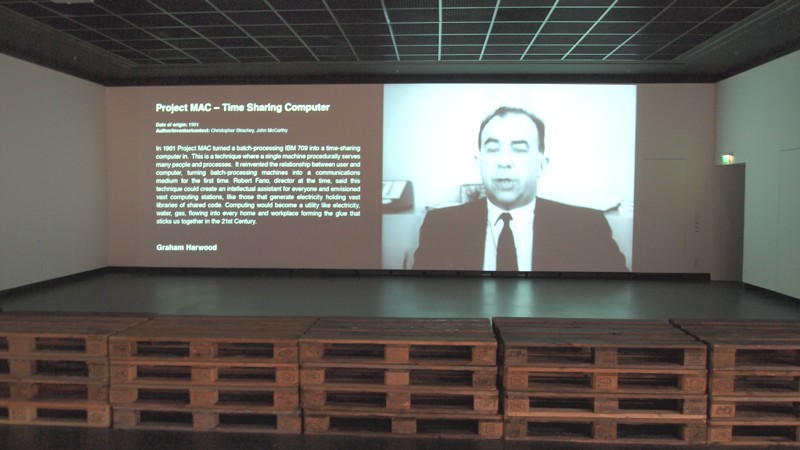
The “forgotten” or “invisible” media is also the subject of YoHa’s (Matsuko Yokokoji and Graham Harwood) installation Evil Media Distribution Centre, based on the 2011 book by Matthew Fuller and Andrew Goffery, Evil Media. Both the book and the installation draw on the “grey” media that usually do not end up in museum vaults or art collections – like a piece of wire and a photocopier, as in the YoHa installation, or various instructions and visual materials from conferences, in the case of Fuller and Goffey’s book. These media have a huge effect on the contemporary world, shape as they do our behaviours and attitudes.
Case #4
The bottom-line of Gert Lovink’s report – we need alternatives to popular social networks that, however effective in cases like the revolution in Egypt, nevertheless have a major flaw – their lack of privacy. Even though the report was little more than a student paper (listing some 20 alternative social networks), what could have been of some interest was the imperceptible particularity of social networks. The listener was left pondering on differences between traditional social networks and the less popular ones, encrypted or decentralized social networks. It would have also been interesting to hear more about the BitCoin, virtual currency used in peer-to-peer networks. According to Forbes, its turnover in US dollars totals 23 million per annum in the Silk Road network alone. (http://www.forbes.com/sites/andygreenberg/2012/08/06/black-market-drug-site-silk-road-booming-22-million-in-annual-mostly-illegal-sales/).
Case #5
…
[nggallery id=1]