
Filter:

2013-10-18
User Manual: Interdisciplinary Arts
Laima Kreivytė
Published in the “In the Graveyards of Interdisciplinarity (?)” catalog, Vilnius, 2013. Republished from cultural weekly “7 meno dienos”, No. 13 (935), 01-04-2011
I must confess – this essay was inspired by a phone call. The caller suggested that there should be a clearer definition of interdisciplinary art. I was politely asked to give it some thought. I was given a week and assured that nothing would happen even if I did not come up with anything.
I usually avoid taking part in phone surveys. But the caller was not from a bank or a pizza house, it was an artist whom I respect and whose concern for interdisciplinary art was sparked not by personal ambition but a responsible approach to public duty. That is something rare indeed, almost an anomaly. I have always been impressed by this artist’s conceptuality and appreciation for complex phenomena and theories. Even in this case – the man could simply “follow his heart” or just shrug it off and waste no more time on it. But he takes interest. Because universal shrugging it off is what bears commercial, kitsch, pseudo-conceptual, official, and modern folk art monsters that get filed by culture bureaucrats in the pile of “interdisciplinary art” projects out of sheer inertia (or resignation). This pile has grown so big that it comes to resemble the Augean stables – and no white curtains can cover it up.
2013-10-16
Keywords of the Current Art: Interdisciplinarity, Media, and Relational Aesthetics
Dovilė Tumpytė
Published in the “In the Graveyards of Interdisciplinarity (?)” catalog, Vilnius, 2013. Republished from interdisciplinary online magazine balsas.cc, 17-10-2005.
Art and theory develop through perpetual change. Some art theorists propose a multitude of terms in order to give an objective description of forms and strategies of contemporary artistic practices, criteria for reading art; others critique them. In the Lithuanian art theory discourse, shaped under specific circumstances of art policies, the most common refrain is a binary classification of art into traditional and contemporary, which usually means art pieces produced within the boundaries of a particular branch/discipline on the one hand interdisciplinary art on the other. Such commonly-accepted classification seems to be quite primitive. One needs a more diverse array of instruments to understand art. In order to grasp contemporary art – evolving in whichever direction, progressive or regressive, unable to contain itself in the traditional, linear modernist art history – I choose theoretical keywords that can feel the pulse of artistic practices at different angles: interdisciplinarity, discourse-specific art, postproduction, relational art.
2013-10-11

Legalise contraband1
Saulius Leonavičius, 2013
Notes from Contrabbando* creative workshop, organised by Migrating Art Academies (MigAA) in Nida Art Colony (NAC).
How an object or a text could become a means for a different content? What is the difference between concrete blocks stuffed with cigarets and an activist’s head stuffed with anti-state information? The question which I brought into Contrabbando* workshop in NAC is this: (How) can an institution become a laboratory of sabotage? This in particular concerns an institution situated a few kilometers away from the border of an empire; an institution, which however plays a representative role in cultural field as a white cube or as an academic space. Can ideologically conflicting ideas, radical in relation to any existing norms, be possible within such institution? Can the meaning of an offense be explained and re-evaluated in a situation where only subordinated norms of an institution have been disobeyed. Can such creative workshop become an event the meaning of which would be measured according to the amount of threat?
2013-08-30
Contraband. A Challenge for Young Artists
Once we hear the word „contraband“, we imagine dark coloured images straigt away – drugs, human trafficking, illegal cigarettes. However Vilnius Art Academy invites to look at this phenomenon from a wider point of view. Participants of Migrating Art Academies from different European countries will gather for a creative workshop organised in Nida Art Colony 1-15 September and will try to give this word a different meaning. All lectures during this event will be open to public.
2013-08-14
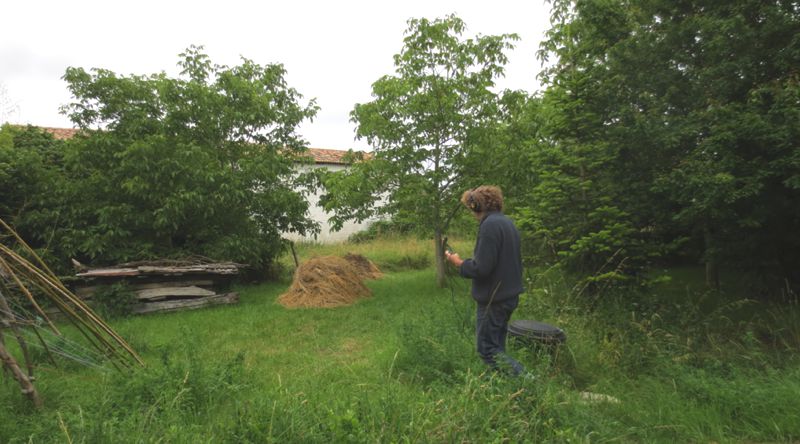
Migrating Art Academies. Voices. 21-27 October 2013
Application deadline for the new MigAA laboratory VOICES is August 28th. For statements, please use our online registration form. Invited artists will be granted travel costs and accommodation.
Certain sounds cannot be perceived by an adult’s ear while they are easily heard by a child’s ear. And a sound doesn’t always sound the same – listen again and again, and new sounds appear. Dogs hear sounds that are outside of our frequency spectrum. Some people hear voices from ghosts, others don’t.
Gigacircus Media Art Group is hosting the new Migrating Art Academies laboratory “Voices” and invites emerging artists to experience Villefagnan together with Sylvie Marchand (FR) and Horacio Gonzales (ES), using sensory input, perceived by the senses or augmented by technological devices.
During the laboratory participants will explore voices phenomena and analyse the sense of hearing. Villefagnan inhabitants will guide the artists to discover local sounds, while the artists will offer unique sound layers on top of the local reality. The collected data resulting from the shared ‘aural experience’ between village dwellers and artists will be conceptualised, interpreted and transmitted through the medium of their choice and put together into a tangible form.
The Voices is organised by Gigacircus Media Art Group in collaboration with Lithuanian Interdisciplinary Artists’ Association. The laboratory is supported by Lithuanian Culture Support Foundation and Nordic Culture Point. Migrating Art Academies is a network for innovation and exchange in arts teaching and research.
Horacio Gonzales, sound artist, developer, open source software for locative audio, http://www.notours.org
Sylvie Marchand, artist, initiated numerous international mobile art works and projects, http://www.gigacircus.net
Further information and registration to the laboratory is open on http://www.migaa.eu
2013-08-11
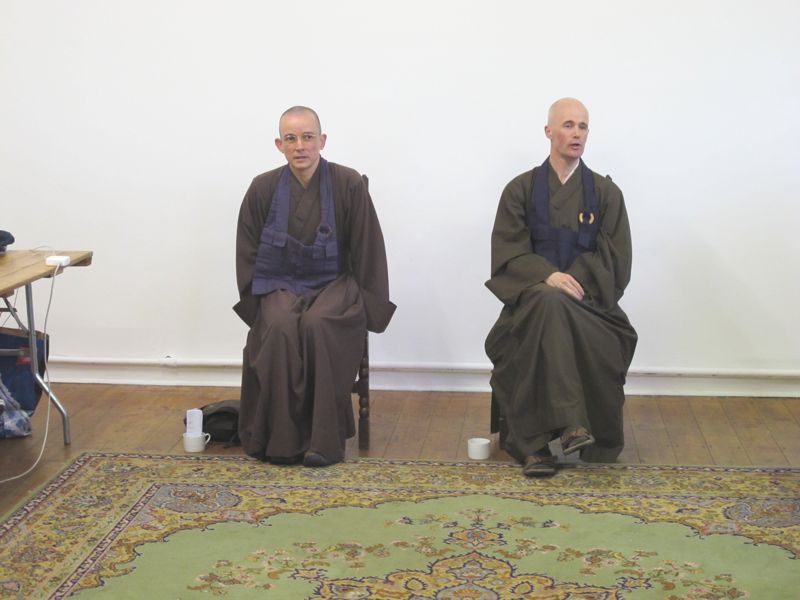
Review: 95%…
Alan Smith and Rosalind McLachlan
Review of the 95%… laboratory, organised by the Lithuanian Interdisciplinary Artists’ Association in collaboration with Allenheads Contemporarry Art and Vilnius Academy of Arts.
In Allenheads, a small ex-mining village that sits high in the North Pennines, you are always at the mercy of the elements; the rain feels wetter here, the wind stronger, the winter longer and the midges hungrier.
2013-06-22
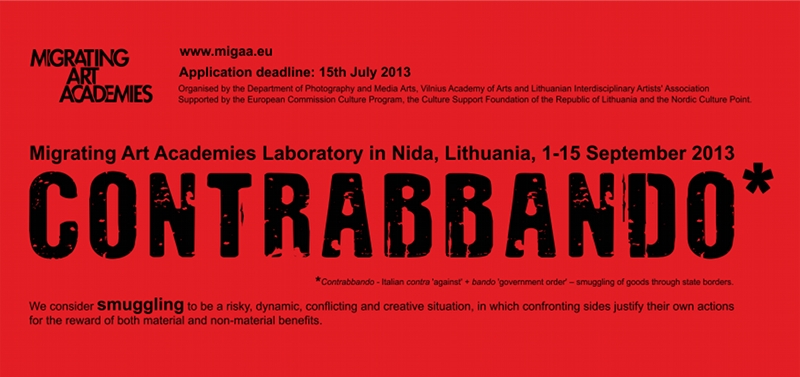
Invitation for applications to Fireplace: Contrabbando* laboratory in Nida
Application deadline July 15th. Please use the online form for registration: http://www.migaa.eu/fireplace-contrabbando/registration/
Invited artists will be granted travel costs and accommodation.
Nida, 1-15 September 2013
* In Italian contrabbando – contra ‘against’ + bando ‘government order’ – illegal smuggling of goods through state borders.

2013-05-24
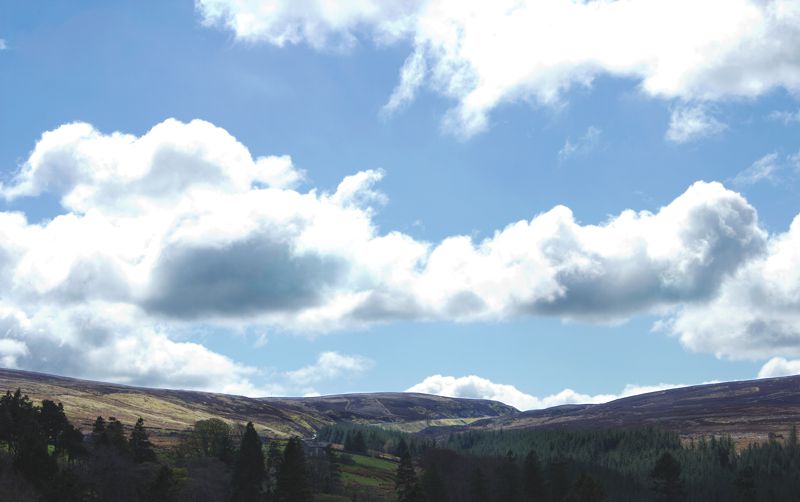
95%…
Migrating Art Academies laboratory at Allenheads
August 5 – 11, 2013
Application deadline 8th of June. Registration is open. Invited artists will be granted a travel bursary and accommodation.
In April 2013 Alan Smith left his house on a hill and thought about his observational capabilities. He was considering the 95% of stuff apparently out there but currently out of sight. He wondered if imagination and creativity might help us make sense of the inexplicable, or create the inexplicable. Is it faith that makes us believe in the intangible and if so, how can that sit comfortably with scientific thinking?
2013-04-26
View Older Entries